Officially, Audi quotes a fuel-efficiency figure of 31.0mpg for the RS 3, with a corresponding 207g/km of CO2. Our most recent time behind the wheel of the RS 3 saw a real-world return of just over 28mpg, although gentle motorway runs will see that creep up to around 33mpg. Naturally, plenty of enthusiastic driving (or revving it loudly in your local town centre) will see that figure drop.
The kickback comes in towns and cities, because despite a decent stop-start system the RS 3 does get through fuel when pottering at low speeds. We also found that the dual-clutch transmission has particularly conservative mapping, meaning that it can feel quite sluggish and slow to respond. Other running costs will be higher than average, thanks to the wide, high-spec tyres and the aggressive suspension geometry run, particularly on the front axle.
The RS 3 is the only new car on sale to have a wider front rubber than rear, with a 265-section width up front and just 235-section tyres on the rear. The standard Pirelli P Zero set-up is good, but for those wanting to extract the ultimate performance from their RS 3, Audi UK now offers the option of track-focused Trofeo R rubber. When fitted, the car’s dry-road performance is lifted up to another level, but the softer compound will require replacing more often, and they’re more expensive as well. The big brakes also need to be looked after, and while the optional ceramics make short work of track days, pad replacements can be even more expensive.
| Insurance group | |||
| Audi RS 3 Sportback TFSI quattro S Tronic | 30.1mpg | 214g/km | 37 |
| Audi RS 3 Sportback TFSI quattro Carbon Vorsprung | 29.7mpg | 215g/km | 38 |
| Audi RS 3 Saloon TFSI quattro S Tronic | 30.4mpg | 211g/km | 37 |
Insurance groups
Depending on the trim level you choose, insurance groups for the RS 3 range from 36 to 39 out of 50. Insurance for a car like this is never going to be cheap but you could still save a few pennies compared to owning a Mercedes-AMG A45 S, as that sits in group 40.
Every RS 3 is way above the £40,000 luxury car tax threshold, so you’ll need to add an extra £440 onto your annual VED road tax bill between the second and sixth year of ownership.
There’s only one thing about the Audi RS 3 that we can call slow, and that’s depreciation. Our market data shows that both the Sportback and Saloon will retain between 53 and 57 per cent of their initial value after three years or 36,000 miles. This makes the Audi a stronger investment than the Mercedes-AMG A 45 S, as that only manages 48 per cent.
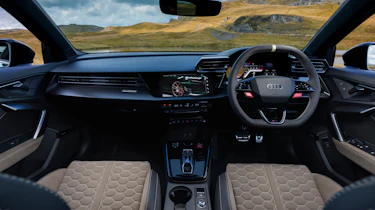
Tech is effective, but dated. Quality is good, but the materials are a little lacking
|
|
The RS 3’s build quality inside is fine, but many of the plastics aren’t up to the standard of typical Audis, let alone one costing the thick end of £60,000. There have been a few improvements in quality in certain areas compared with the previous version – we’re talking about small elements inside the air vents and door cards – but in general too many of the hard-finish plastics are still there and feel cheap.