Latest Porsche Macan Electric deals
Compare the best electric cars
Check out the specs of our top electric car recommendations below and click the links to jump back up to the mini-reviews.
| Prices from | Max charging speed | Boot space | |||
| Nissan Leaf | £29,000 | 375 miles | 150kW | 7.6s | 437 litres |
| BMW iX3 | £53,000 | 500 miles | 400kW | 4.9s | 520 litres |
| Skoda Elroq | £32,500 | 355 miles | 175kW | 5.4s | 470 litres |
| BMW i3 | £45,000 | 566 miles | 400kW | 4.7s | 420 litres |
| Cupra Raval | £24,000 | 277 miles | 105kW | 6.8s | 441-litres |
| Mercedes CLA | £45,000 | 461miles | 320kW | 6.7s | 405 litres |
| Kia PV5 Passenger | £33,200 | 256 miles | 150kW | 10.7s | 1,310 litres |
| Volvo EX60 | £57,000 | 501 miles | 370kW | 3.9s | 523 litres |
| Renault 4 | £23,500 | 249 miles | 100kW | 8.2s | 339 litres |
| Porsche Macan Electric | £69,800 | 398 miles | 270kW | 3.3s | 480-540 litres |
Key updates
-
BMW i3 and Porsche Macan Electric added following respective 5 and 4.5 star reviews.
-
Major update with Nissan Leaf, 2026 Car of the Year, moved to first place. Volvo EX60 and Cupra Raval added.
-
BMW iX3 added in 2nd place after 5-star review and Supertest win. Mercedes CLA replaced VW ID.7 as best long-distance EV.
-
Format change to list the best EV of each type and be more useful to buyers with different requirements. VW ID. Buzz added as the best seven-seat electric car after long-term test result and VW ID. 7 added as best long-distance electric car.
How we choose the best electric cars
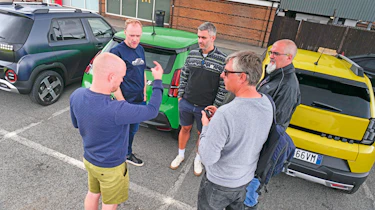
Our extensive testing programme examines every new car on sale in detail.
We test every aspect of the vehicle’s make-up. But with pure-electric models we pay particular attention to the following areas – and so should you when taking your test drive:
- Fast charging speeds
- Good regenerative braking system with natural responses
- Good charging cable storage
Beyond that, we test the same things we look for on any car, from the driving experience to the infotainment system and the practicality of the interior. All are carefully evaluated by our experts to determine exactly where the car sits in relation to similar models that you might be considering.
We also know that price is a huge factor for EV buyers, with 52% of our readers telling us that finding the best deal is the most important part of the car-buying process for them, so our experts also analyse the market to carefully compare the prices, plus the leasing and finance deals, of each model. All-in-all, our extensive testing process is designed to bring you the definitive verdict on the best electric cars to buy.
If you'd like more recommendations around your specific electric car requirements, check out these guides:
Not sure if electric cars are right for you? Take a look at the available according to our road test team.
Electric cars still work best for drivers who can charge at home or work, but growing public charging networks do make them a viable option for those who can’t. If you mostly drive short distances and can access cheap and convenient charging, an EV could be ideal.
Long-distance drivers should check charging station availability along their usual routes and be conscious of the added cost associated with charging away from home.
Electric cars have zero exhaust or tailpipe emissions so they don’t produce the localised NOx and particulate emissions that have a damaging effect on air quality in urban areas. However, the overall environmental credentials of an electric car depend greatly on the source of the electricity used to charge it. As the energy mix of the National Grid moves towards renewable sources like solar, wind and tidal power and away from fossil fuels, electric cars get greener. Green NCAP has published whole life emissions estimates for various cars with small electric vehicles performing better than any ICE cars.
Electric cars are still selling in relatively small numbers and we haven’t seen enough of them doing significant mileages to make a firm judgement on reliability. What we do know is that EVs have fewer moving parts than conventional cars and there’s little evidence from hybrid or electric cars that battery performance degrades substantially with use, although you are likely to see a gradual reduction in capacity over time.
Modern electric cars are designed with practicality in mind. Most now use dedicated EV platforms, optimizing passenger and boot space without the compromises seen in early EVs that were converted from ICE cars. Whether you need a compact city car or a spacious family SUV, there’s likely to be an electric model that meets your needs. EVs actually suit the SUV shape because the higher seating position leaves room under the floor for the batteries.
EVs offer instant torque, smooth acceleration, and a quieter experience compared to petrol and diesel cars. Many come with regenerative braking that slows that car when you release the accelerator, allowing for one-pedal driving in stop-start traffic. It all makes urban commuting more efficient and less stressful. Many EVs can outpace sports cars when accelerating from a standstill - even some quite innocuous looking ones dip under 5 seconds for the 0-62mph sprint.
With improving battery technology, electric cars are increasing their ranges all the time. Many models now pass the 400-mile barrier with the likes of the BMW iX3, Volvo EX60 and the Mercedes CLA around the 500-mile mark on a charge.
Pure-electric cars have had to pay VED road tax since April 2025. There's a £10 first year rate then £200 per year after that. Electric cars costing over £50,000 also attract the expensive car supplement - this applies to petrol cars too but above the lower level of £40,000.
EVs can have higher upfront costs than petrol or diesel cars but the gap is closing and many models are now available at similar prices. The EV Grant has helped bring prices of cheaper EVs down and manufacturers are discounting EVs to hit government ZEV mandate targets.
Running costs are significantly lower for EVs. Charging at home is cheaper than refuelling with petrol although the most expensive public rapid chargers can be a similar price to fuelling an ICE car.
Maintenance costs are reduced due to fewer moving parts and reliability should be good. EV batteries are expensive to replace but have long warranties and should outlast the typical life of the car. Company car drivers also benefit from tax incentives.
There's more information to help you make your electric car choices in our full guide on if you should buy an electric car