This will be offset by above-average insurance costs, and for an EV, the servicing costs are quite chunky.
Electric range, battery life and charge time
A modest 29.6kWh battery is fitted to the Super-N (that’s smaller than the 31.8kWh pack found in a Range Rover PHEV), while Honda quotes WLTP range figures of 128 miles combined, or 199 miles on the WLTP City cycle.
During our time with the Super-N, we drove on a mix of urban and motorway routes in hot weather, and yet the trip computer refused to budge from an efficiency figure of 4.7 miles per kWh. Achieve the same result, and you’re looking at a range of 139 miles, and you’re likely to get closer to the WLTP City figure if you keep your speed down.
This goes some way to overcoming the battery’s small size, and means you don’t necessarily need to charge the car every time it’s parked. From a standard home wallbox, the battery takes four hours to charge from 15 per cent to full capacity (a figure we achieved in the real world), but DC charging isn’t the fastest. There’s a maximum rate of 50kW, but because the battery is so small, it still takes the industry-standard half an hour to go from 15 to 80 per cent capacity.
| Battery size | Insurance group | ||
| Super-N | 29.6kWh | 128 miles | 27 |
Insurance groups
One of the areas where the Super-N might not be cost-effective is for insurance. Its Group 27 rating is high for a city car; a quote of £546 was more than we received for the Group 23-rated Hyundai Inster Cross (£451) for our sample driver.
The Super-N’s relatively low costs continue when it comes to state-levied charges, with Benefit-in-Kind rates among the lowest on the market. For 2026/27, standard-rate taxpayers have annual costs of £151, courtesy of a low P11D figure and the four per cent levy that applies to all EVs.
A 47 per cent residual rating for the Honda Super-N after three years and 36,000 miles is decent for a city car. The Hyundai Inster is in the 39-41 per cent range, while the electric Fiat 500e is closer to 30 per cent. The MINI Cooper Electric is only marginally better, ranging from 46-51 per cent.
We love the chunky exterior of the Super-N, and while the interior isn’t quite so audacious, it does a lot of things right.
|
|
The kei-car class offers plenty of opportunity for innovation within compact dimensions, and the Super-N has lots of smart touches. On the outside, the upright shape of the N-One has been beefed up with boxed wheelarches and bigger bumpers inspired by the Honda City Turbo II to create the Super-N, but it’s still pretty small on UK roads.
Interior and dashboard design
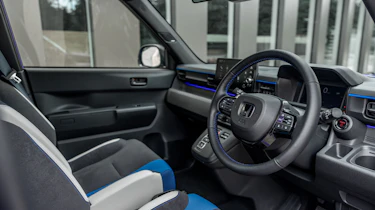
While the exterior is bound to turn heads, the cabin is more restrained, but not without neat touches. There’s lots of familiar Honda switchgear, from the drive selector to the window switches, while the black dash is lifted by blue highlights and subtle ambient lighting. The front seats have a mix of cream artificial leather, grey Alcantara and blue fabric inserts, which give the cabin a boost.
Materials and build quality
You’d expect some cost cutting due to the Super-N’s low price, but that’s far from the reality. Japanese car makers such as Honda spend as much time and money developing and refining their kei cars as they do larger models, and this shows in the overall quality of the Super-N. From the way that it drives to the feel of the steering wheel in your hands, this little Honda benefits from decades of development and refinement, and there are no really obvious signs of cheap materials.
Infotainment, sat-nav and stereo
While the Super-N is a brand-new car for the UK, the Honda N-One that it’s based on has been around in its current guise since 2020, so the tech on board is a little behind the cutting edge that you’ll find elsewhere in the class.