How do you adapt a Hollywood hit for the stage – whether as a play or musical – knowing that the original is so beloved many will be unable to move past it? It’s a question I often wonder, and one that It’s a Wonderful Life faces on two counts. Not only is Franz Capra’s life-affirming 1946 drama beloved and revered, but it’s also a Christmas film. People don’t just know and love it, but return time and time again, the actors’ faces indelibly buffered into our minds with every yearly rewatch.
Some don’t see that as a problem; just look to Broadway, where Andrew Rannells, Megan Hilty and Titus Burgess can currently be seen in Joe Landry’s stage adaptation. But over at London’s Jermyn Street Theatre, a different tack is being taken. This is not It’s a Wonderful Life (the play of the film), but It’s a Wonderful Life! (the radio play of the film). Here, a tight ensemble cast guides us through George Bailey’s life, director Jessica Lazar creating a rich piece of theatre that might not live up to the original, but still strikes the balance between originality and nostalgia.
In the early 20th century, George Bailey (Griffin Stevens), a polite, kind man who is deaf in one ear, lives a distinctly average life. A dreamer, he longs to escape his hometown of Bedford Falls, yet is kept there by the obligatiosn of family and community, and grows to resent the life he lives. That’s why on Christmas Eve 1945, two angels (Stefan Bednarczyk and David Webber) see George considering taking his own life, and flash us back through his years on Earth.
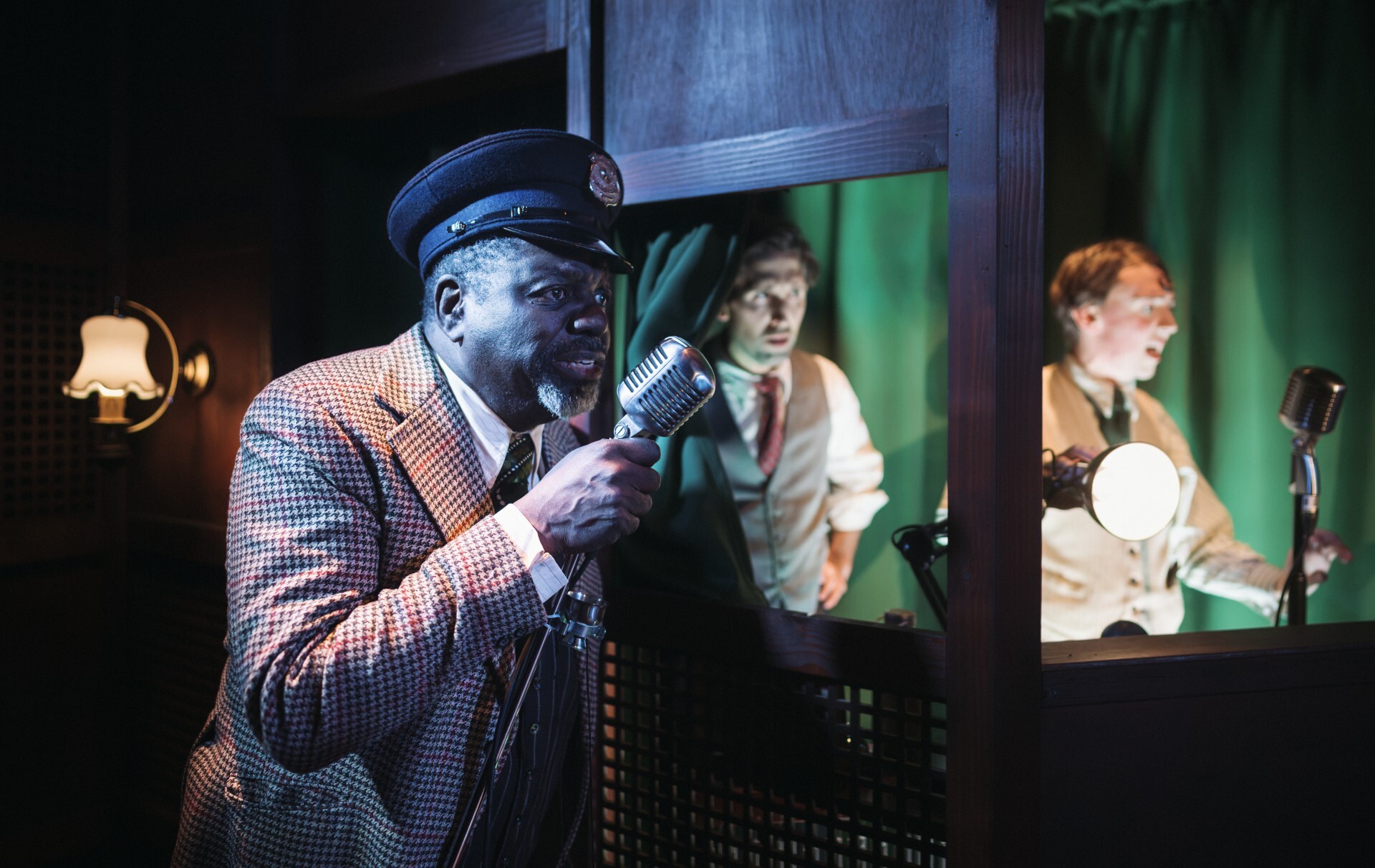
In Antony E Palermo’s script, the radio play serves as a framing device. The ticketholders (ie us) are the live studio audience, and the stage is the radio theatre on which the work is created. Tina Torbey’s set is plush yet homely, with rich wood panels and low, inviting light. It’s a place where the cast can be themselves, laughing at each other's jokes and cheering on their performances and all the while adding to Capra’s message about community and family.
A talented troupe of multiroling actors and foley artists playing across age and gender, the six-strong cast create the swirling world of Bedford Falls in front of our eyes (and ears). As George and his wife Mary, Stevens and Iniki Mariano as his wife Mary are on hand to ground the production, and take on this somewhat thankless task with grace. Elsewhere, it’s character range and bombast that are most appreciated. Mary Higgins (best known for their work within feisty Fringe duo Hotter) really shines when multiroling, with an ability to play the steely Mr Potter one second and the cherubic child Zuzu another.
With each on-stage, old-school microphone serving as a miniature stage in itself, the production is best imagined as a series of tableaus. Around each mic the cast orbits, playing with depth and distance to distort voices sound as they would in pure radio. Stop speaking, and they adopt the role of live sound effect artists, creating the bustling world of Bedford Falls under sound artist’s Odinn Orn Hilmarsson’s design. They crumple paper bags and scratch pencils. Sometimes they kiss their own hands.
Fascinating as it is, the on-stage foley can detract from what’s actually happening in the plot. Auditory intrigue is traded for clarity – which, given the ubiquity of It’s a Wonderful Life, is an understandable exchange (although those less well versed may struggle to keep up).
This being an audio play, I did shut my eyes (deliberately, to be clear) a couple of times to absorb Palermo’s script as intended. Yet there is no visual laziness to Lazar’s direction. The cast play actors within a radio studio, but they also embody the characters themselves, donning costumes and pulling facial expressions for the live audience only to indulge in. Whether it’s the delightful dichotomy between Webber’s deep, smooth voice and his bright, playful energy, or Lachlan Werner holding court internally as his own characters comedically converse (with a smattering of his trademark ventriloquistic artistry), there’s something joyful about watching the cast throw everything at this production. Does it all stick? No, but they’re clearly having a blast doing it. And isn’t that what Christmas is about, after all?