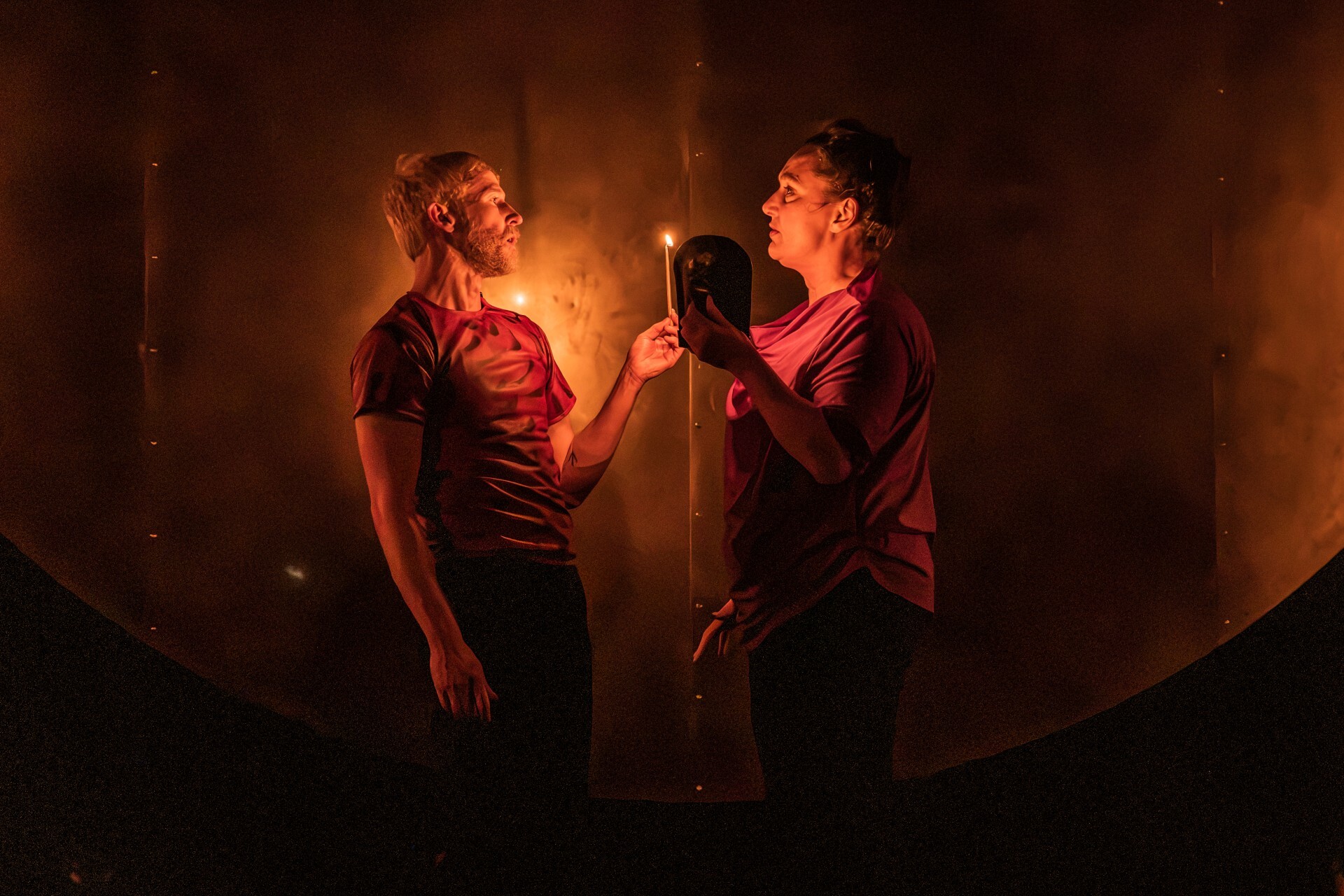
has one of the biggest casts of all Shakespeare’s plays, almost 50 characters, from spear carriers to fourth plebeians. Not here. Even by the standards of director Joe Hill-Gibbins, whose previous takes on Shakespeare have included buckets of blood, fields of mud and mountains of sex dolls, this is a radical redoing. Just four actors turn the sometimes flabby play of power and politics into a four-person battle royale, a brutal fight to the death. Intense isn’t even close. This is a brilliant act of butchery, leaving just the leanest, bloodiest, choicest cuts.
All that remains are Brutus, Cassius, Antony and Caesar on a candlelit stage in front of a huge disc of beaten gold. A small fire barely lights them as they dance around it like feral animals, shadows on the wall, foreshadows of their later madness. Drumming starts up, and never stops for the next 90 minutes. It’s like being sucked into a particularly acute anxiety attack.
At first we get a pair of . Natey Jones’s Cassius, wired and wily, chatters so excitedly that his voice keeps veering higher, lines ending almost with a squeak as he urges his mutinous plans on pal Brutus. She, meanwhile, as played by Caoilfhionn Dunne, is no prevaricating, gentle soul, as often played. Instead she’s a slightly dense sponge, excitedly soaking up Cassius’s radicalising screeds.
Then it’s over to Adam Gillen, a gimpish and submissive Antony, circling Kate Duchene’s imperious Caesar, who is the quietest, calmest person on stage. But she turns nuts too. Without the soothsayer to warn her of the Ides of March, Hill-Gibbins makes Caesar schizophrenic, as Duchene does a Smeagol/Gollum kind of thing, switching between herself and the prophet of her own doom. She sticks a finger down her throat, retches and suddenly speaks gutturally, prophesying her own death. It’s like Caesar is her own civil war.
On the small Sam Wanamaker stage there is necessary closeness to these actors, and Hill-Gibbins really leans into it. They writhe around each other, stroking hands around bodies, across necks, their faces almost touching as they talk to and about each other. Meanwhile, with just a couple of candles used as a roving torch, they build layers of reflections and shadows on that dull gold disc, while you hear every few minutes in that reduced script the constant references to fire, reflection and illumination.
Then we get to the high point, Caesar’s funeral. First, Brutus’s speech. Dunne delivers it with the smugness of some anonymous patriot account bloviating on X (‘Who is here so rude that would not be a Roman? Who is here so vile that will not love his country?’). Up next, Anthony’s ‘friends, Romans, countrymen’ centrepiece, a performance of staggering, blazing intensity by Gillen that seems to capture the whole play in miniature: first hesitant, flickering, then building to a conflagration.
It’s a speech that can lose its momentum when the various plebeians interrupt with their reactions. Not here: Antony plays them too. He leaps across the stage, ‘Poor soul, his eyes are red as fire with weeping’, he says of himself, and chants ‘The will, the will, we will hear Caesar’s will!’ to himself. He’s a one-man mob, set to a deafening drumbeat. He almost tears himself apart, bursting out of his own edges, screaming, throwing himself at that gold disc, thrashing a drum, thrashing himself, while the smug smiles on Brutus and Cassius’s faces turn to horror. Who needs four plebeians, when Gillen brings the energy of 400.
The fault, dear Brutus, is not in the production but in the play itself. When that speech is over, the rest isn’t as good. War, ghosts, and too much chat. Hill-Gibbins keeps it blissfully short, and brings some more magisterial touches – Duchene rises from the dead to play Caesar’s heir Octavius as well as Caesar’s ghost - but it still falters a little.
There are no noble ideals here, Brutus is not a gentle, conflicted soul, as he’s often played. Everyone is awful, everyone is mad, and everything is on fire. It’s a short shock of a for an age when ‘men have lost their reason’.