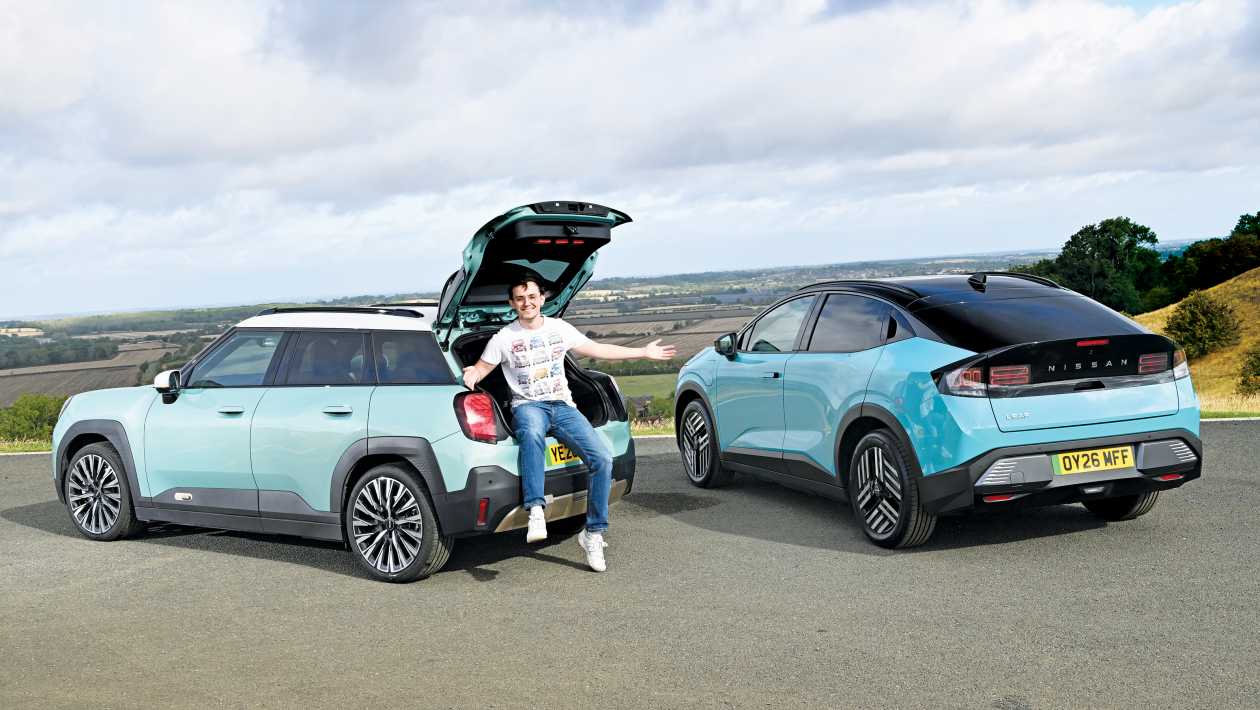
Let’s start with the price. Given that it’s manufactured in China, the Aceman isn’t eligible for the Government’s Electric Car Grant. As such, it costs about the same as the larger MINI Countryman – a far more accomplished and practical EV. Moreover, the Nissan Leaf is a similar proposition to the Aceman – it’s a small family car – but is priced significantly lower. It’s built in Britain, so it gets the full £3,750 grant, which means the Advance model we have here costs around £5,500 less than our MINI.
That’s not the end of it. Despite both sitting in the same segment, the Leaf is also much more practical than the MINI. There’s more legroom in the rear of the Nissan, although both offer decent headroom and a generally airy feel, thanks to hi-tech panoramic roofs; the Leaf’s glass can be frosted at the press of a button, while the Aceman’s illuminates as part of its extensive ambient-lighting pack.
Given that it’s only my partner, Victoria, and me who regularly use the MINI, it has been more than spacious enough for us. However, families going on holiday might struggle with the Aceman’s 300-litre boot; the Leaf’s cargo area is nearly 140 litres larger. What’s more, at nigh-on £40,000, I would have hoped the Aceman and its Level 3 option package would have come equipped with a powered bootlid.
Finally, we must address the range, with the Aceman having been tested thoroughly in both city and motorway driving. I’ll often take it to and from the airport, while Victoria will occasionally use it for a drive through town to work that usually lasts around 10 minutes or so. Returning an average of 4.1 miles per kWh, we’ve achieved a real-world range of 200 miles – fine for most people, although the sluggish charging speed can be annoying when we’re out and about. Even if the MINI gets anywhere near its 100kW maximum, that is.