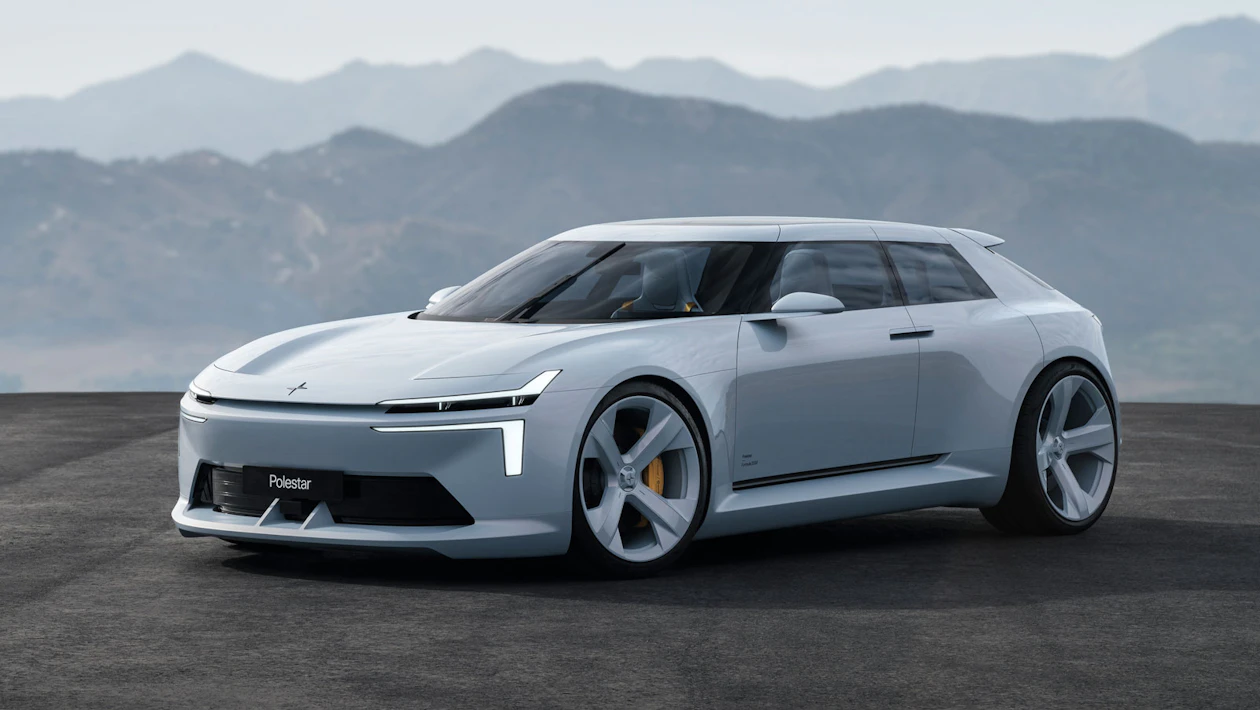
To the rear, Polestar’s single LED light bar (something that’s become a design trait of the firm) as gone. There are now two narrow light clusters and Polestar says they give off a ‘UFO-esque’ rear. The rear window, like the front, has a wraparound design and it’s topped off by a roof-mounted spoiler, plus a huge diffuser incorporated as a bumper beneath.
To enter the Formula 2030 you open up the pillarless doors (rear-hinged for the back doors) where you’ll find a rather innovative and slick yet quirky cabin. Up front there’s a curved instrument display mounted on the steering column to create a driver-orientated environment – helped further by a cocooning dashboard that flows into the centre console.
That centre console is where things really get interesting. The 12.2-inch central display – which features Google built-in like Polestar’s current models – has a new interface and can rise up or fall flat against the dash. Beneath it there’s a sliding drive-mode selector and you can see each setting on the screen behind. Polestar says it created this function as a balance between physical and digital control.
Then beneath that is a control panel with purely physical switchgear. While beautifully finished, they’re not groundbreaking in their own right, but they are entirely customisable. You can physically swap out each of the eight controls, such as the rocker switches or rotary dials to your preferred layout. Juan Pablo Bernal, Polestar’s head of interior design, said: “With the Formula 2030 concept we're reducing the unnecessary, distilling the experience to its very essence and enhancing the elements that truly matter to set the tonality and ambition for future Polestar interiors.”