For home charging, Range Rover will offer its own wallbox design, promising smooth interoperability with the car and app. Charging the battery takes seven hours on a 22kW wallbox, so it’ll require a few sessions to reach capacity at homes with single-phase electricity. A couple of EV capabilities – ‘vehicle to grid’ to sell electricity back to the network and ‘plug and charge’ automated billing – aren’t ready to roll out to UK customers at launch.
Looks like a Range Rover, and no compromise on practicality
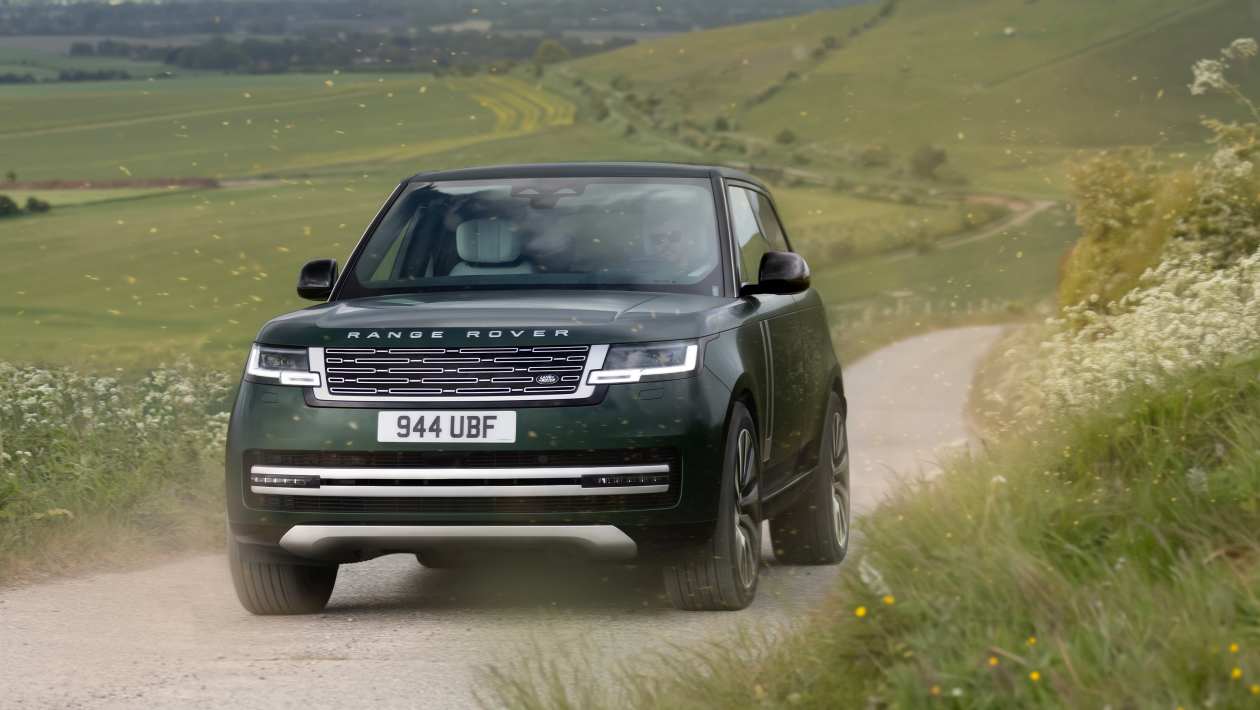
Externally, the Range Rover Electric looks almost identical to its siblings, apart from the blanked off grille and new alloy wheel design to smooth airflow. But due to the lower-hanging battery and reduced ride height it sits slightly closer to the ground, boosting efficiency along with the optimised underbody. The bespoke rear diffuser also helps while protecting off-roading approach and departure angles.
“From the carpets up, the interior is identical to the combustion version’s, with no compromise on cabin space,” said Simon Fairbrother. That preserves the huge 818-litre cargo area. But there’s no hidden ‘frunk’ in the nose: users would likely get their clothes dirty trying to reach into the distant storage area.
Front motor U-turn caused 18-month re-engineering shockwave
Initially a different EDU design – an induction motor – was fitted to the front axle. With superior freewheeling ability when disengaged, the goal was to drive efficiency. But during extreme physical testing in 2024 – the EV550 has to nail five runs up and down Dubai’s 300-foot Big Red sand dune – the motor was prone to overheating.
“It needed changing to a permanent magnet motor for repeatable performance,” explained Rachel Hogg. “That was a big decision that took time to get right.” Suddenly the team had to double rear EDU supply, redesign the front cradle, rewrite the software and prove it in the field – an 18-month re-engineering project.
How much is the Range Rover Electric?
JLR claims the EV550 waiting list now stretches to 80,000 people, with more than two-thirds new to the brand. “20 per cent of them already own an EV but aspire to a Range Rover,” said Martin Limpert.
The entry-level EV550 Autobiography (standard wheelbase) costs £154,070, with prices rising through First Edition, SV and SV Black trims to £190,320. The long-wheelbase version starts at £215,670 for the SV, with the SV Black at £225,240. But with Range Rover expanding its bespoke services, eco-minded plutocrats will be able to pay a whole lot more for a one-off with tailored materials, paints and unique embroidery.
Click here for our list of the best electric SUVs on sale right now...