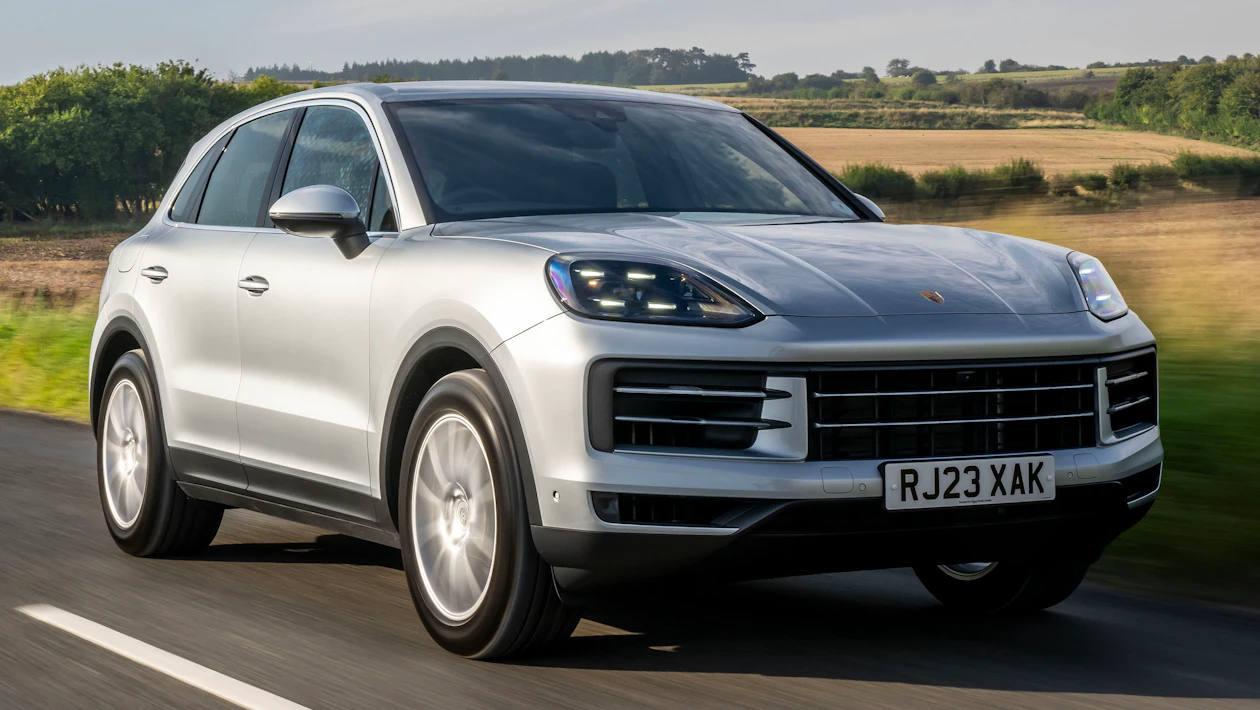
The more rakish Cayenne Coupe shares the same exterior dimensions as the regular model.
| Dimensions comparison | |||
| 4,918mm | 4,922mm | 4,922mm | |
| 1,983mm | 2,047mm | 2,004mm | |
| 1,696mm | 1,820mm | 1,745mm | |
| 2,895mm | 2,997mm | 2,975mm | |
| Boot space |
698-772 litres (standard) 627 litres (E-Hybrid) |
647 litres | 650 litres |
Despite a relatively low roofline and the sporty, low driving position (for an SUV, at least) the Cayenne ensures all but the tallest occupants, who are well over six feet, have plenty of space above their heads.
Legroom is good in both the front and rear seats, but the high transmission tunnel means front-seat occupants don’t get the same sense of spaciousness at their elbows than in more upright SUVs like the Range Rover Sport. The rear seats are comfortable, and the bench slides forward and back to trade legroom against extra luggage space. There’s no seven-seat option, though.
Isofix points are located on the front passenger seat, and in the outer positions on the rear bench.
Boot space
The Porsche Cayenne’s boot space is rated at an impressive 772 litres with the rear bench slid all the way forwards (698 litres with the seats all the way back) for petrol models, expanding to 1,708 litres with the versatile 40:20:40 split folding rear seats down. That’s much bigger than the Range Rover Sport.
However, the tables turn with the plug-in E-Hybrid Cayenne, because the battery pack under the boot floor eats up space and reduces total volume to 627 litres, which is slightly shy of the equivalent Range Rover Sport. The Cayenne still has 1,563 litres of boot space with the seats down, which is more than said rival has.
Both the petrol and plug-in hybrid versions of the Porsche Cayenne have impressive towing capacities. Every model can pull a hefty 3,500kg braked trailer or caravan, which is on a par with both the Land Rover Discovery and Range Rover Sport.