2023 Ford
23,651 miles1.5L
2022 Nissan
22,010 miles1.5L
2026 Audi
37,724 miles1.5L
2023 Peugeot
208
20,119 miles1.5L
We've conducted a thorough road test of the Toyota Aygo X against the Citroen C3 as part of a twin test.
The Aygo X is a surprising amount of fun, with hybrid drive complementing its lively chassis
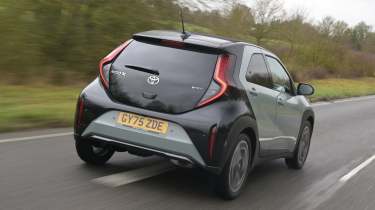
|
|
Adding hybrid drive to the Aygo X not only means there’s greater efficiency when compared with the old 1.0-litre model, but there’s an increase in performance, too. The powertrain has been carried over directly from the Yaris, so there’s a 1.5-litre three-cylinder petrol engine with a small electric motor and battery pack, while power is sent to the front wheels through a CVT transmission.
Given that the Aygo X is based on a shortened Yaris platform, the petrol engine, electric motor and gearbox fit relatively easily under the bonnet. Toyota did lengthen the car’s nose ever so slightly, but it doesn’t look unnatural or cobbled together.
A greater challenge was presented when considering the battery, though, because placing it under the back seats, as in the Yaris, was no longer an option. Instead, Toyota has split the 0.76kWh battery into two banks directly under the rear-seat cushions, which leaves a slightly odd seating position.
To achieve this, and to also leave enough space for a fuel tank, the floor was redesigned by Toyota’s European development team. All this work was worth it, though, because of the improvements in both power and efficiency.
While the Aygo X is at the very low end of the spectrum when it comes to small cars fitted with big engines, the benefits on paper and at the wheel are blindingly obvious. Acceleration is considerably faster than in the previous generation, with the latest model being 5.7 seconds faster from 0-62mph. A sub-10-second sprint time is decent for any car, especially one designed for city driving.