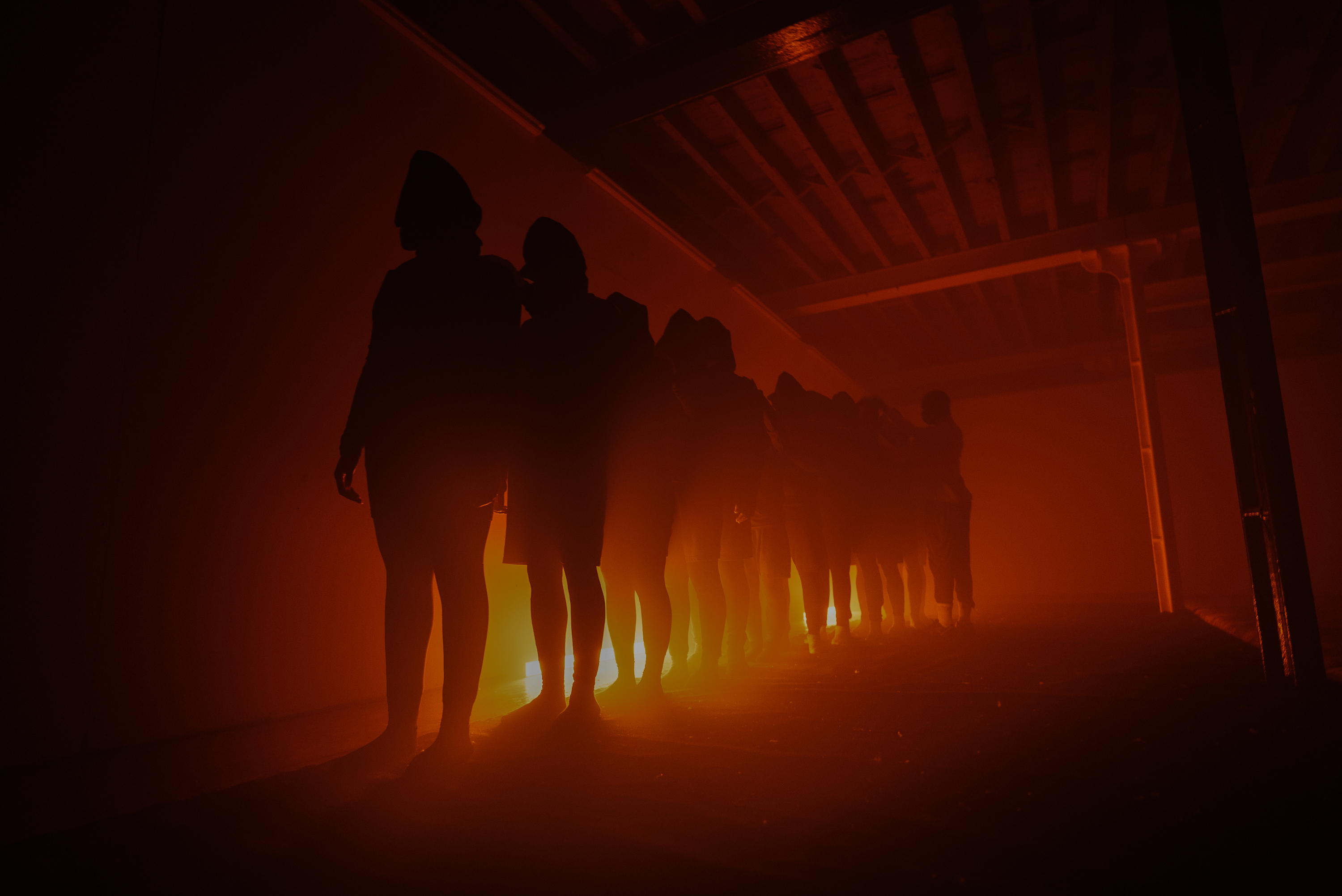
About 20 minutes into The Waldorf Project: Chapter Five/Kaihogyo I came as close as I’ve ever come to having a panic attack, which I’m not really sure is a recommendation in and of itself but is certainly confirmation that this is some very visceral immersive theatre.
Like its predecessors, it’s not for the faint of heart. is the umbrella name for an ongoing series of sense-altering events from artist Sean Rogg, with this the fifth entry and the first in seven years. Kaihogyo is a 1,000-day walking pilgrimage undertaken by Tendai Buddhist monks of Mount Hiei in Japan in pursuit of enlightenment, and Rogg’s stated aim is to convey something of that in a piece of theatre. Albeit one that does not last 1,000 days.
My almost freak out came early in the three-hour-plus, interval-free experience, which takes place in a chilly warehouse in Islington. Having already changed into black thermal uniforms, in the first proper room of the experience, impassive, unspeaking performers dole out blackout hoods that completely cover our faces. Our feet are bound by velvet cuffs that mean we can only shuffle very slowly, guided by another audience member with no hood on.
By the grand finale I found myself going quite dreamy
This goes on for a really very long time and I’m not quite clear what the intended effect was but – not wishing to suggest these were entirely comparable experiences – I did start idly thinking about my grandmother’s time in a Siberian gulag as I was marched around the freezing cold room in a hood and shackles. I’m not sure it was so much that that set me off – though it didn’t help – so much as the suspicion the experience would only stop if I asked for it to stop and that I was actually being very hardcore and everyone else had long ripped off their hoods (they hadn’t, I’m just a wimp clearly).
I think perhaps the issue is that there’s very little guidance as to how you should be feeling or what any of this might mean, leaving my mind to drift towards the more, uh, aspects of Rogg’s show: hoods, shackles, black uniforms, cold temperatures, being made to stand in fixed positions, being made to march in line, etcetera. It’s not giving gulag.
I won’t describe every single room, but it does mellow out significantly after that first bit (the hoods stay in play but the manacles are a one off). We’re led very through a series of spaces that are typically defined by a coldly pulsing and droning electronic score and further – if gentler – exercises in sensory deprivation and modification. It becomes quite meditative, especially on the top level, where you’re laid down and even tucked under blankets. Often you’re positioned in contact with another human in an intimate, if not intrusive way.
Did I achieve enlightenment? I mean obviously not but by the grand finale I found myself going quite dreamy and spending a lot of time quite absorbed in the ceilings and wallpaper. Does that really justify the whole thing? I think perhaps my brain is wired the wrong way for what Rogg is going for, as some participants had clearly got a lot more out of it come the end, while I was still musing about what it might have to say about death camps.
I would say approach with caution, and that a mindset pre-disposed to meditation is liable to help, but if you want a properly challenging immersive experience, this is certainly it.